In Warsaw, Kraków, and most of Poland's larger cities, December through February brings days where usable light for plant growth — measured as photosynthetically active radiation (PAR) above the 100 µmol/m²/s threshold — amounts to three to four hours at best, often less on overcast days. Even a south-facing windowsill in January is marginal for most crops.
For herbs and greens grown indoors between October and March, supplemental lighting isn't an enhancement — it's a prerequisite. This article covers what types of lights are available, how to compare them, and what realistically works for small-scale home growing of basil, mint, lettuce, arugula, and similar crops.
What plants need from light
Plants use light in the 400–700 nm wavelength range for photosynthesis. Within that range, blue light (400–500 nm) drives compact vegetative growth and is most important for herbs and leafy greens. Red light (600–700 nm) promotes flowering and fruiting. A lamp that provides both blue and red, in roughly a 1:4 ratio, works for most herbs and vegetables.
The amount of light is measured in PPFD (photosynthetic photon flux density) — micromoles of photons per square metre per second (µmol/m²/s). For leafy greens and herbs that don't flower: 150–300 µmol/m²/s for 12–16 hours per day is adequate. For fruiting crops like tomatoes: 400–600 µmol/m²/s is needed, which requires more powerful fixtures and smaller grow areas.
Fluorescent tubes — the original grow light
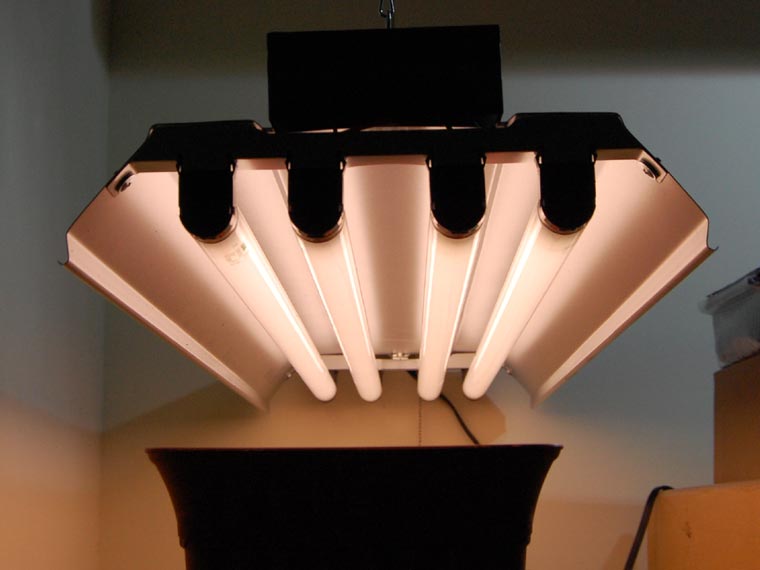
T5 and T8 fluorescent tubes were the standard for indoor growing for decades. They produce a full-spectrum light that includes both blue and red wavelengths, run cool enough to place within 5–10 cm of plant canopies, and are inexpensive to buy. A single T5 HO (high output) 54W tube provides adequate light for a 30×120 cm growing area when placed 10 cm above the plants.
The main limitations of fluorescent lights today are efficiency and bulb lifespan. They typically produce 80–100 lumens per watt, compared to 120–200 lumens per watt for modern LEDs. Bulbs degrade over time and should be replaced after 10,000–15,000 hours of use even if they're still glowing — output drops significantly before visible failure. For small-scale herb growing on a single shelf, fluorescent lights remain a functional choice if the equipment is already available.
LED grow lights — the current standard

LED grow lights have replaced fluorescent as the default for most home growers. The advantages are significant: lower energy consumption for equivalent light output, longer lifespan (50,000+ hours), minimal heat output, and available in specific spectra designed for plant growth.
Types of LEDs for home use
Full-spectrum LEDs — panels that produce white light covering the full 400–700 nm range, often with elevated blue and red output. These are the most versatile and the most common type sold for home growing. A 30W full-spectrum LED panel covers roughly 30×30 cm at the light level needed for herbs, placed 20–30 cm above the canopy.
Red/blue "blurple" LEDs — older design that combines deep red (660 nm) and blue (450 nm) diodes only, producing a characteristic purple-pink light. Efficient for plant photosynthesis but difficult to use for visual inspection of plants (colour rendering is poor) and less pleasant in living spaces. Now largely replaced by full-spectrum options.
Bar-style quantum boards — high-density LED arrays in a flat bar format, producing very uniform light distribution. Used in commercial growing and by serious home growers. Overkill for a windowsill herb setup, but useful for a full grow shelf or tent.
Comparing options for a typical Polish apartment setup
Most people growing herbs indoors in a Polish apartment are working with one to three shelf levels, containing somewhere between four and twenty plant pots. For this scale, practical options are:
- Clip-on LED desk lamps with full-spectrum bulbs: Low cost (50–120 PLN), easy to position, adequate for a few pots of herbs within 15–20 cm. Output is limited — realistic for mint, chives, parsley, and lettuce in low-light months; not sufficient for basil without extended hours (16+ hours per day).
- Panel LED grow lights (20–45W): Better coverage, designed for growing. 150–250 PLN for a usable model. A 30W panel from a brand like Mars Hydro, Spider Farmer, or Viparspectra covers 30×30–40×40 cm adequately. These run 14–16 hours per day on a timer.
- All-in-one countertop gardens (Click & Grow, AeroGarden): Integrated containers, LED lighting, and sometimes hydroponic medium. Convenient but expensive per plant slot. Useful if you don't want to manage individual components. The Click & Grow Smart Garden 9 costs approximately 400–500 PLN and grows nine plants simultaneously.
Practical settings for common herbs
Basil: 14–16 hours of light per day. Keep the lamp within 20 cm of canopy. Basil is the most light-hungry herb on this list — insufficient light produces elongated, pale plants with poor flavour. A timer is essential to maintain consistency.
Mint: 12–14 hours. Tolerates lower light levels than basil. Can grow acceptably under a standard desk lamp with a full-spectrum LED bulb. Does not need intense light to produce flavorful leaves.
Parsley and chives: 12–14 hours. Both are cool-season crops that handle lower light reasonably well. Parsley grows slowly regardless of light level — set realistic expectations for weekly harvest quantity.
Lettuce and arugula: 12–14 hours. Compact LED panels work well. Arugula in particular grows quickly under supplemental light and can be harvested within 3–4 weeks of sowing.
Distance, burn, and bleaching
LED lights placed too close to plants cause bleaching — leaf tissue turns white or pale yellow near the light source. This is photoinhibition, not a nutrient deficiency. The correct distance depends on fixture wattage: low-wattage LEDs (10–20W) can be placed 10–15 cm from the canopy; 30–50W panels should stay at 25–35 cm. Manufacturer PPFD charts (if provided) are the most reliable guide.
Fluorescent lights run cool and can be placed 5–10 cm from plant canopies without risk of heat burn.
Timers and photoperiod management
Running lights manually is impractical and inconsistent. A mechanical outlet timer costs 15–25 PLN at most Polish hardware stores and ensures the light cycle is maintained even when you're away. Set it to match the natural photoperiod extended by supplemental hours: if natural daylight is 4 hours, add 10–12 hours of artificial light for a 14–16 hour total day. For herbs and greens, there is no benefit to running lights more than 18 hours — plants use the dark period for certain metabolic processes, and continuous light can cause leaf malformation in some species.
A mechanical timer and a 30W full-spectrum LED panel are the two items that most improve the reliability of indoor herb growing in Polish winters. Everything else is secondary.

